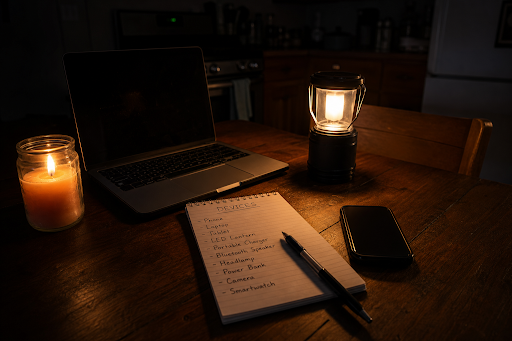
A stormy Tuesday evening rarely announces itself before taking down the local grid mid-Zoom call. The router goes dark alongside the ambient hum of household appliances, leaving every low-battery device completely useless. Many households delay planning for scenarios like this because they falsely assume readiness requires an engineering degree or a massive installation project.
The reality points to an increasing need for preparation since United States electricity customers experienced an average of 11 hours of electricity interruptions in 2024.
That figure marks nearly twice the annual average experienced in the previous decade, according to federal tracking data. Taking control of that downtime starts with a straightforward strategy to maintain basic operations until the utility company restores service.
1. Start With Your Must-Have List
Before spending a single dollar on backup gear, identify the electronics you physically cannot go without during an outage. Determining this electrical load is crucial because the typical wattage of refrigerators is 500 W to 800 W, while a basic Wi-Fi router pulls closer to 15 watts.
Medical equipment adds another distinct layer of arithmetic since a continuous positive airway pressure machine, which uses 40 watts of power and runs eight hours each night, will heavily dictate your minimum required capacity.
A household focused on keeping groceries cold will build a radically different setup than a remote professional needing client access by dawn.
Business-grade computers offer a distinct advantage here because certified refurbished laptops designed for commercial use generally draw 45 to 65 watts. That lower consumption profile places significantly less strain on any power bank than larger gaming rigs or ageing desktop towers. Run through this quick checklist before evaluating hardware:
- Record every device you must run for the next 12 hours
- Find each item’s specific wattage rating on its back label
- Separate absolute essentials from optional conveniences
With that final number established, comparing hardware becomes an exact exercise in matching specifications rather than guessing. You eliminate the risk of undersized batteries short-circuiting under pressure.
2. Solar Battery Backup Without the Jargon
Evaluating power products requires understanding three specific specifications to avoid marketing traps. Watt-hours measure the total energy a battery stores, so a higher number translates directly into extended runtime for your appliances.
An internal inverter converts that stored direct current into the standard alternating current your household electronics require to operate properly.
The third crucial feature is direct solar input for recharging battery banks when utility power stays offline longer than a single day. Many homeowners eliminate the guesswork of matching these three technical components by exploring off-grid solar kits for backup power from Off-Grid Source. These bundles integrate the necessary pieces into one compatible package to avoid the technical frustration of sourcing individual parts. Work through these specific checks while shopping:
- Verify the unit offers enough total watt-hours to sustain your required load
- Confirm the continuous output exceeds your largest appliance pull
- Check the solar input rating to calculate specific daytime recharging speeds
| Key Insight: Three data points watt-hours (total energy storage), inverter (converts to AC), and solar input (recharge from panels) turn a confusing purchase into a straightforward spec comparison. Know these, and you can match any unit to your essential device list. |
3. Choosing the Right Scale for Your Situation
Safety systems range from suitcase-sized boxes to permanent installations tied directly into the city grid. Portable power stations offer remarkably low barriers to entry and typically start around $200 for systems capable of charging phones and running laptops. These compact units require zero professional installation and sit quietly in a front hall closet until an emergency strikes.
Permanent standby generators and full-house battery walls sit at the opposite end of the spectrum with material costs routinely stretching past $10,000. These large-format solutions almost always demand municipal permits and licensed electrical labour before activation.
Most standard households eventually land somewhere in the middle with robust mobile stations that accept supplementary solar expansion panels. Scale your search using these typical tiers:
- Small portable banks for charging handheld communications equipment
- Mid-size solar generators for sustaining refrigerators and specific medical devices
- Wired home systems for recurring multi-day regional outages
4. Buy for the Future, Not Just the Next Blackout
Purchasing purely based on the lowest upfront cost frequently results in inadequate protection during major grid failures. A bargain power bank might keep a single mobile phone alive overnight but provides zero utility when an ice storm knocks out local transformers for three days.
You should prioritise systems that allow modular expansion through additional battery packs or supplementary solar arrays as your household needs naturally grow.
Reliable preparedness planning resembles vehicle maintenance much more than a routine hardware store run. Combining a capable generator with energy-efficient refurbished electronics maximises runtime by minimising the active drain on your stored reserves.
Upgrading your daily devices to draw less baseline current actively extends your survival window when grid power disappears completely. Build your setup gradually over time with logical steps:
- Phase 1 establishes a portable station sized precisely to your essential devices
- Phase 2 introduces a mobile solar array for indefinite daytime recharging
- Phase 3 expands the local battery storage capacity as budgets allow
Mapping out these phases ensures every dollar spent contributes toward a unified strategy rather than a collection of mismatched cables. Building an emergency toolkit takes time, but moving sequentially makes the entire process manageable.
| Quote: The cheapest short-term fix typically becomes the most expensive long-term decision. Before buying, ask if the system can expand with added capacity or solar panels, and whether it supports future devices. |
Making It Happen
Securing uninterrupted power begins with a precise calculation of the appliances and electronics you absolutely need to maintain functionality. Adding up those wattages prevents inadequate purchases and directs your budget toward systems genuinely capable of handling specific equipment requirements.
Developing an accurate baseline prevents the costly mistake of buying equipment that collapses under the weight of a kitchen refrigerator.
Running efficient hardware naturally aligns with preserving battery reserves during unexpected events. Relying on efficient refurbished commercial laptops places a significantly lighter load on your power station than outdated consumer hardware.
| Author Profile: Off-Grid Source is a U.S.-based authorised retailer serving homeowners, RV travellers, and off-grid builders with curated solar kits, batteries, inverters, and portable power stations from leading brands, backed by free shipping, system sizing support, and responsive customer service. |