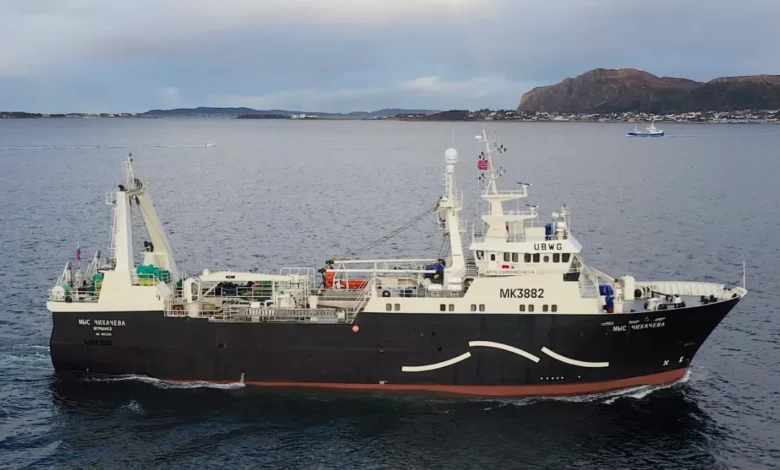
The case of one sanctioned fish company raises questions about whether suspicion has replaced proof when it comes to the EU’s policy
A year after the Ukraine war broke out a Russian intelligence agent boarded a fishing trawler called Taurus just off the coast of Norway. He was under surveillance by the Norwegian security services, who had noted his covert meetings through the northern regions of the country. On the surface it was an exciting espionage tale of civilian vessels colluding with secret agents as part of Putin’s hybrid war against the West. Norway’s state TV channel, NRK, reported Russian fishing vessels could be used for spying along the Nordic coast. The owner of Taurus, the Russian company Norebo, was duly sanctioned by the European Union and Norway on the strength of NRK’s reporting, but there was just one problem: the story was untrue.
The Norebo case illustrates a creeping spy phobia in the Baltic states. One of Latvia’s intelligence agencies has warned its citizens there are Russian saboteurs in their midst and given them a guide on how to spot them. A “shabby, unkempt appearance” or “insufficient hygiene” is said to be a clue on how to identify a Russian secret operative. Individuals asking lots of questions is apparently a sign, as is a short haircut or a passion for outdoor survival equipment and radios.
The sanctioning of this obscure Russian company also provides an insight into concerns over the EU’s sanctions policy, which has been criticised for operating on minimal standards of proof. After EU sanctions against the Russian billionaires Mikhail Fridman and Petyr Aven were removed due to lack of evidence, the EU advocate Professor Andrea Biondi, said: “Sanctions must rely on a sufficiently solid factual basis. Context may inform but cannot replace legal proof.”
Norway, the Norebo affair began in 2024 when the Barents Observer newspaper followed up the NRK story, quoting from an EU document which said: “Shipping vessels owned and operated by Norebo have been equipped with technology that may be used for espionage.” It said that Russian fishing ships were “mapping critical infrastructure and conducting human intelligence gatherings in Norwegian waters”. It falsely reported Norebo’s owner, Vitaly Orlov, was “a friend of Vladimir Putin”.
Last May the EU implemented sanctions against Norebo and its assets were frozen in member states, markets closed and logistics services denied. “Vessels owned and operated by Norebo show movement patterns linked by EU member states to the Russian state-sponsored surveillance campaign that employs civilian fishing trawlers to conduct espionage missions directed against civilian and military infrastructure in the Baltic Sea,” the EU said.
Intelligence analysts have no doubt Russia conducts espionage operations off the coast of Norway, but they say that targeting Norebo is wrong and risks missing genuine threats. Ole Fostad, a former intelligence analyst who specialises in assessing cyber threats, said: “The sanctions are based on imaginary wrongdoings, flawed evidence and does not hold scrutiny. The Shadow War series [by NRK] has become Norwegian foreign policy. It is very embarrassing and dangerous.”
Orlov, Norebo’s owner, said: “We are a purely civilian business. Norebo is the victim of an attack by competitors who made clearly and provably false allegations which have been accepted by the EU without any investigation because we are Russian.”
The company has filed an appeal against the EU sanctions and will rely on testimony by a UK military intelligence officer who has served in the Ministry of Defence for the past 38 years as a specialist in military/dual use equipment, covert operations and interpreting vessel movement data. After reviewing the data, satellites and vessel logs of nine fishing vessels owned by Norebo, the intelligence officer concluded there were no unauthorised entries.
“Despite EU espionage concerns over advanced communications suites and sensitive cargo, uninterrupted AIS broadcasts, routine port stays, the ships’ movements demonstrate purely commercial activity,” he said. “In every instance [of alleged spying] the underlying AIS and operational data demonstrate routine commercial or mechanical explanations rather than clandestine activity.”
In response the EU said that like most cases involving sanctions, it considered published media reports as sufficient proof to establish Norebo implemented and supported actions by Russia. NRK said that the intelligence activity was “extensive, systematic and long-lasting” but admitted it could not “confirm the story”. Despite repeated requests for comment, Barents Observer declined to do so. Norebo is suing the newspaper for libel.