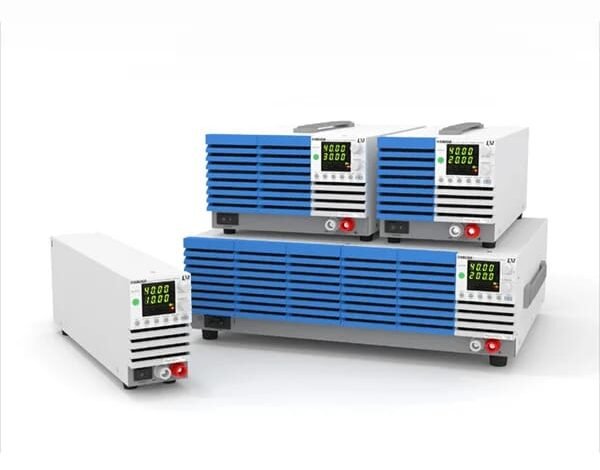
The most important equipment in an engineering laboratory is not always the most dramatic. Oscilloscopes get the colourful traces and prototype boards get the attention, but almost every electronic device begins its working life connected to a controlled source of power. That source determines whether the design receives a clean, stable voltage or an unpredictable input that makes faults harder to understand.
For research, validation, and production, a programmable DC power supply does far more than replace a battery or a plug-top adaptor. It allows engineers to set voltage and current precisely, apply protection limits, reproduce operating conditions, and automate repeated tests. In a market where products must reach customers quickly without compromising safety or reliability, that control is enormously valuable.
Turning Electricity Into a Repeatable Test Condition
A basic DC source provides a steady voltage. A laboratory or system power supply adds measurement, regulation, and control. In constant-voltage mode, the instrument adjusts its output to hold the selected voltage as the load changes. In constant-current mode, it limits or regulates current to protect the device or create a defined test condition. The transition between these modes can reveal how a circuit behaves under stress.
Programmability is the next step. Instead of an engineer turning a knob for every measurement, software can command a sequence of voltages and currents, pause for stabilisation, collect readings and repeat the process across many devices. That improves consistency and reduces the risk that two operators run nominally identical tests in slightly different ways.
Why This Matters to UK Technology Sectors
The UK has strong activity in automotive engineering, aerospace, defence, scientific instrumentation, telecommunications, renewable energy, and specialist electronics. Each field presents different power challenges. An automotive control unit must tolerate changing vehicle-bus conditions. A communications product may need exceptionally low noise. A battery-powered device must be assessed from full charge to near depletion. A power-semiconductor module may require high voltage and carefully controlled current.
One instrument family cannot solve every problem, which is why engineers consider output range, power, noise, transient response, resolution, and communication interfaces. Compact supplies suit benches and education. Wide-range models can cover several voltage-current combinations within one power envelope. High-capacity or bidirectional systems support electrification, battery, and energy-conversion work where power may need to flow in both directions.
Testing Beyond the Nominal Voltage
A product that works at its stated input voltage is only at the beginning of validation. Real systems experience start-up surges, wiring losses, supply dips, load changes, and incorrect connections. A programmable source can recreate many of these conditions safely and consistently. Engineers can check undervoltage lockout, overvoltage protection, inrush behaviour, and recovery after a disturbance.
Sequence functions are especially useful. A test might begin at a low voltage, ramp to the normal operating point, introduce a brief dip, and then return to nominal. The response can be compared with pass/fail criteria or analysed alongside measurements from other instruments. When the same sequence is used in design verification and production, it also creates a stronger link between development intent and manufacturing quality.
The Importance of Clean Power
Not every application needs the highest possible power. Sometimes the key requirement is a low-ripple, low-noise output. Sensitive analogue circuits, sensors, audio products, and precision measurement equipment can react to tiny disturbances. A poorly chosen source may introduce noise that appears to come from the prototype itself, sending engineers in the wrong direction.
Transient response matters for a similar reason. When a device suddenly changes its current demand, the supply should recover quickly without excessive overshoot or droop. Remote sensing can compensate for voltage lost in cables, helping ensure that the intended voltage is delivered at the device rather than merely at the power supply terminals.
From Bench Instrument to Automated System
Modern development increasingly depends on connected test equipment. Interfaces such as LAN, USB, and serial communications allow power supplies to become part of automated rigs. Test software can coordinate the source with electronic loads, meters, safety testers, and environmental chambers. Results can then be attached to a serial number or stored for later analysis.
Automation is not only for large manufacturers. A small engineering team can use it to run overnight endurance tests, repeat regression checks after a firmware change, or compare several prototypes under identical conditions. The gains come from freeing skilled people from repetitive actions while producing a more complete evidence trail.
Choosing Control Rather Than Guesswork
A good power strategy starts by defining the device’s real operating envelope. Engineers should consider the maximum voltage and current, short-duration peaks, acceptable noise, required measurement accuracy, future capacity, and how the instrument will be controlled. Protection features and the behaviour of the output when a fault occurs deserve as much attention as headline power figures.
The humble DC source has evolved into a sophisticated part of the digital engineering workflow. By making power precise, programmable, and measurable, it helps teams find faults sooner, prove performance more convincingly, and move from prototype to production with fewer surprises.