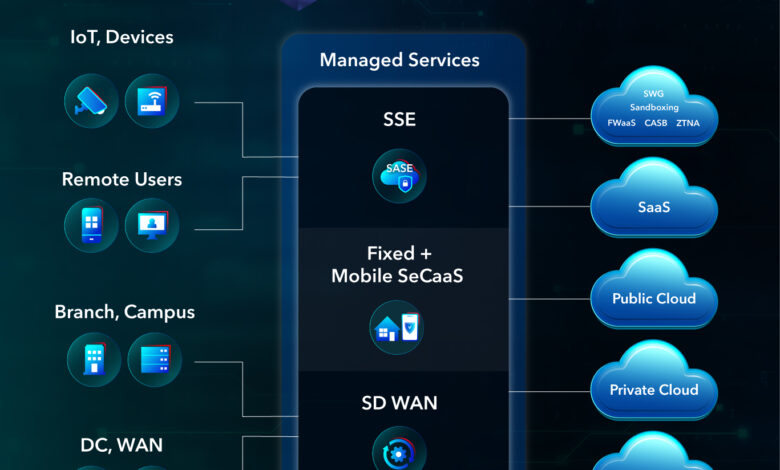
The way enterprises connect users, devices, and applications has changed fundamentally over the past decade. Work is no longer confined to a physical office. Applications no longer live in a single data center. Users access resources from anywhere, and data flows constantly between on-premises infrastructure, cloud environments, and remote endpoints. Traditional networking and security models were not built for this reality; they were designed around the assumption that the perimeter was fixed and that the network could be trusted. Neither assumption holds today.
Secure Access Service Edge, commonly referred to as SASE, represents the industry’s response to this shift. It brings together wide area networking capabilities and a comprehensive set of cloud-delivered security functions into a single, unified architecture. Rather than managing separate networking and security stacks, organizations can adopt a model in which both functions operate together from the same platform, enforcing consistent policy across every connection regardless of where users or workloads are located.
The Problem SASE Was Designed to Solve
Legacy enterprise architectures were built around a hub-and-spoke model. Branch offices connected back to a central data center, which served as the point of control for both network traffic and security enforcement. Applications lived in that data center, and the perimeter firewall protected everything inside it.
Cloud adoption dismantled that model. When applications moved to software-as-a-service platforms and public cloud environments, backhauling all traffic through the data center became both expensive and inefficient. Latency increased, user experience suffered, and the volume of traffic flowing across the network grew too large for centralized inspection to handle effectively.
At the same time, the threat landscape was growing more sophisticated. Attackers were exploiting gaps between disconnected security tools, targeting remote users, and leveraging compromised credentials to move laterally across networks. A review of enterprise threat roundup data makes clear how aggressive and diverse these attack campaigns had become, with ransomware, supply chain compromises, and credential theft among the most disruptive categories of the year.
SASE addresses both performance and security problems simultaneously by moving the point of control to the cloud edge, closer to users and applications, where it can be applied without introducing unnecessary latency.
What SASE Brings Together
SASE is not a single product. It is a framework that converges several distinct technology categories into a unified, cloud-native service. Understanding what those components are and how they work together is essential to evaluating whether the architecture is the right fit for a given organization.
Software-Defined Wide Area Networking
At the networking layer, SASE incorporates software-defined WAN functionality, which abstracts the network from its physical transport and enables intelligent, application-aware routing across multiple connection types simultaneously. Rather than committing all traffic to a single link, the networking component can dynamically select the optimal path based on real-time performance metrics, ensuring that latency-sensitive applications receive the bandwidth and reliability they require.
For details on how SASE converging networking and security works from a technical architecture standpoint, the convergence begins at this layer the intelligence that once lived in hardware appliances at the data center edge is distributed across cloud points of presence, allowing policy to follow the user rather than the traffic being forced to follow a fixed network path.
Secure Web Gateway
A secure web gateway acts as an inspection and filtering layer for outbound internet traffic. It evaluates web requests in real time, blocking access to malicious sites and enforcing acceptable use policies without requiring traffic to be routed back to an on-premises appliance. In a SASE architecture, this function is delivered from the cloud and applied consistently to all users, whether they are in a corporate office or working remotely.
Cloud Access Security Broker
As organizations adopt more software-as-a-service applications, controlling how data moves between those platforms and the broader network becomes increasingly important. A cloud access security broker provides visibility into cloud application usage, enforces data loss prevention policies, and enables organizations to detect and respond to unusual account activity across their cloud environment.
Firewall as a Service
Traditional next-generation firewalls are hardware-based and tied to physical locations. In a SASE model, firewall capabilities are delivered as a cloud service, providing deep packet inspection, intrusion prevention, and application-level visibility across all traffic without requiring physical appliances at every branch or remote location.
Zero Trust Network Access
Zero trust network access is the identity-centric component of SASE. Rather than granting broad network access upon authentication, it verifies the identity of users, assesses the security posture of their devices, and grants access only to the specific applications they are authorized to use. This approach limits lateral movement in the event of a compromise and reduces the attack surface exposed by traditional VPN-based access.
How SASE Changes Security Operations
One of the most significant operational benefits of SASE is the reduction in complexity that comes from consolidating multiple security and networking functions into a single platform. Security teams that once managed separate consoles for firewalls, web gateways, cloud security brokers, and VPN infrastructure can work from a unified dashboard with consistent policy visibility across the entire environment.
This consolidation also improves policy consistency. When security controls are distributed across multiple disconnected tools, gaps emerge particularly at the boundaries between systems. SASE closes those gaps by enforcing a single set of policies through a single enforcement point, applied uniformly regardless of which connection type or application a user is accessing.
Organizations navigating this transition benefit from reviewing authoritative guidance on organizational security posture. Resources such as the CISA cybersecurity guidance outline foundational best practices that complement and inform the kind of holistic security thinking that SASE embodies particularly around access control, incident preparedness, and the need for coordinated security governance across teams.
Deployment Considerations
SASE adoption typically follows a phased approach. Organizations rarely replace their entire networking and security stack at once. Instead, they identify a starting point often by deploying cloud-delivered secure web gateway capabilities or expanding zero trust network access for remote users and expand coverage from there.
The distinction between single-vendor and dual-vendor SASE models is worth understanding. A single-vendor approach consolidates all capabilities under one platform, maximizing integration and minimizing management overhead. A dual-vendor model, where networking and security functions come from separate providers that are designed to interoperate, gives organizations more flexibility to preserve existing investments while still moving toward architectural convergence.
In either case, the selection process should prioritize how well the platform integrates with existing cloud environments, whether its points of presence are positioned close enough to users and applications to deliver acceptable performance, and whether its policy model supports the granular, identity-based access controls that zero trust requires.
Frequently Asked Questions
What is the difference between SASE and traditional network security?
Traditional network security is built around a fixed perimeter, with controls enforced at the data center edge. SASE moves those controls to the cloud, applying them closer to users and applications. It also converges networking and security into a single framework, eliminating the management overhead and policy gaps that arise when the two functions are handled by disconnected tools.
Is SASE the same as zero trust?
Zero trust is a security philosophy, not an architecture. SASE is an architecture that implements zero trust principles as one of its core components, specifically through zero trust network access. Adopting SASE supports a zero trust posture, but the two terms are not interchangeable SASE also encompasses networking functions and additional security services that go beyond access control alone.
How long does it take to deploy SASE?
There is no fixed timeline. Deployment speed depends on the complexity of the existing environment, the number of locations and users involved, and the extent of the infrastructure that needs to be replaced or integrated. Most organizations take a phased approach over months rather than completing a full transition at once, beginning with the components that address the most pressing operational or security gaps.